




Executive Summary
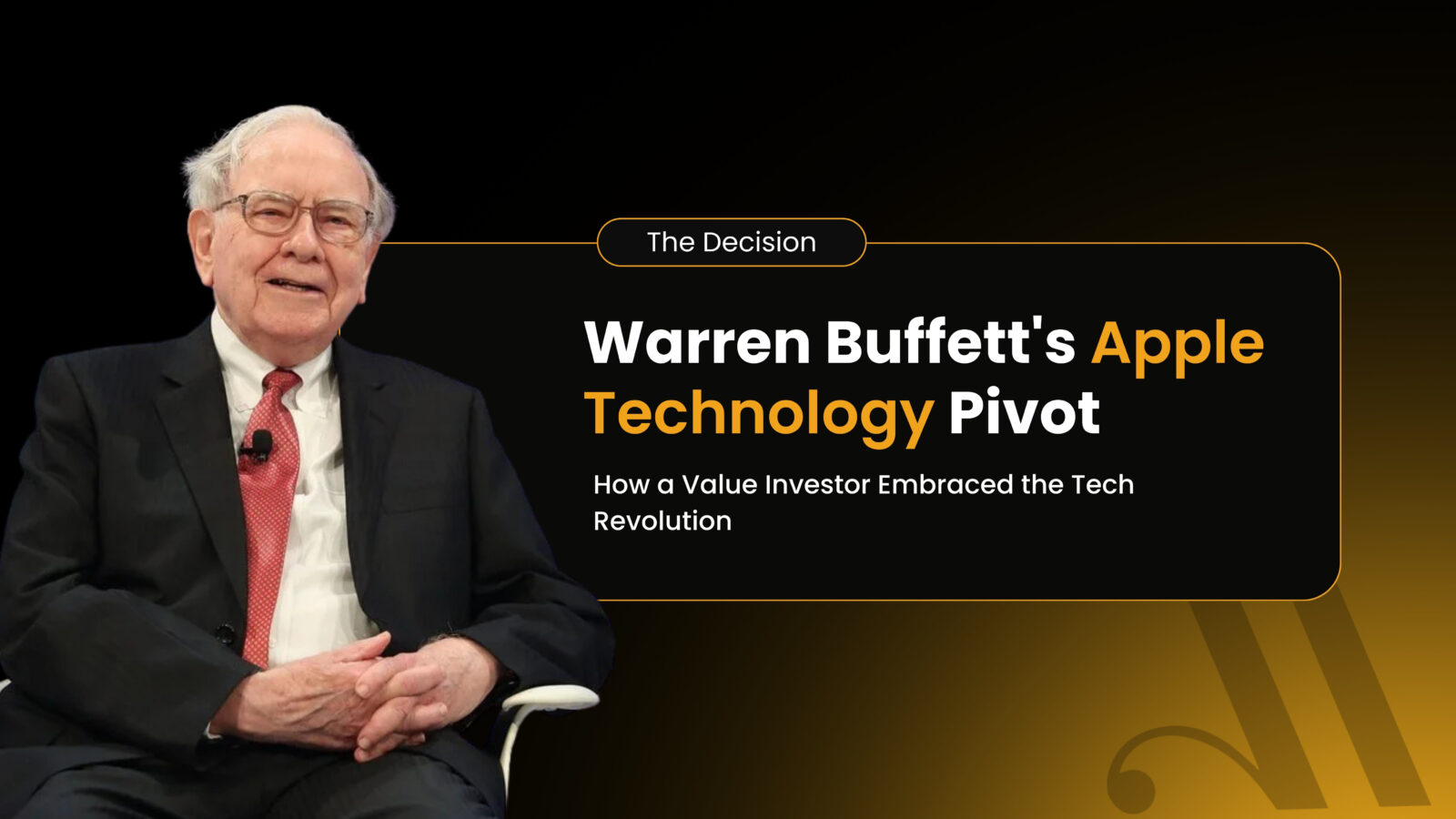
Beginning in 2016, Berkshire Hathaway CEO Warren Buffett initiated a massive Apple investment strategy, accumulating $170+ billion in Apple stock despite a 50-year investment philosophy that explicitly avoided technology companies as incomprehensible and unpredictable. This case study examines how legendary investors can execute fundamental strategy transformations by reconceptualizing technology companies as consumer brands when sustainable competitive advantages become apparent through market maturation.
Market Context and Financial Impact Assessment
Pre-Investment Philosophy and Historical Position
- Buffett’s 50+ year “circle of competence” avoiding technology investments
- Berkshire Hathaway focused on traditional businesses: insurance, railroads, utilities, consumer goods
- Public statements characterizing technology as too difficult to understand and predict
- Apple trading at $95-100 per share with market skepticism about iPhone growth sustainability
Strategic Investment Metrics and Portfolio Transformation
- Initial Investment: $1.1 billion Apple stake purchase in Q1 2016
- Investment Scale: $40+ billion cumulative Apple purchases representing 5.5% of total Apple ownership
- Portfolio Weight: Apple becoming 50%+ of Berkshire’s entire stock portfolio by value
- Market Validation: Apple investment generating $100+ billion unrealized gains
- Philosophy Evolution: Technology reconceptualized as consumer brand with sustainable moats
“Price is what you pay. Value is what you get.” – Warren Buffett
Strategic Decision Framework Analysis
Critical Assessment Parameters
Buffett’s investment team identified three fundamental Apple business model realizations:
- Consumer Brand Loyalty: iPhone demonstrating unprecedented customer retention and switching cost economics
- Services Ecosystem: App Store and iCloud creating recurring revenue streams with software-like margins
- Capital Allocation Excellence: Apple’s share repurchase and dividend strategy optimizing shareholder returns
Strategic Options Evaluation Matrix
| Option | Approach | Philosophy Consistency | Return Potential |
|---|---|---|---|
| Technology Avoidance | Maintain historical anti-tech stance | Complete consistency | Missed mega-cap opportunities |
| Selective Tech Exposure | Small positions for learning and exposure | Moderate philosophy shift | Limited upside capture |
| Major Apple Investment | Large position based on consumer brand analysis | Significant philosophy evolution | Maximum return potential |
| Broad Tech Portfolio | Multiple technology investments | Complete strategy transformation | Excessive complexity and risk |

Implementation Strategy and Resource Allocation
Five-Pillar Apple Investment Framework
1. Consumer Brand Analysis and Sustainable Competitive Advantage Assessment
- Brand Moat: Apple ecosystem creating powerful switching costs and customer loyalty
- Premium Positioning: Sustainable pricing power through differentiated user experience
- Market Share Stability: iPhone maintaining dominant position in premium smartphone segment
2. Financial Performance and Capital Allocation Excellence Evaluation
- Cash Generation: $100+ billion annual operating cash flow providing investment flexibility
- Share Repurchases: Aggressive buyback program reducing share count and increasing ownership percentage
- Dividend Growth: Consistent shareholder returns through progressive dividend policy
3. Services Revenue and Recurring Income Stream Development
- App Store Economics: 30% commission on digital transactions creating software-like margins
- Subscription Growth: iCloud, Apple Music, and services generating predictable recurring revenue
- Ecosystem Lock-in: Integrated services increasing customer lifetime value and retention
4. Management Quality and Strategic Vision Assessment
- Tim Cook Leadership: Operational excellence and strategic capital allocation demonstration
- Innovation Pipeline: Consistent product development maintaining competitive differentiation
- Market Expansion: International growth and emerging market penetration strategies
5. Valuation Opportunity and Market Timing Analysis
- Price-to-Earnings: Apple trading at discount to market despite superior financial performance
- Growth Prospects: Services expansion and emerging technology integration opportunities
- Market Pessimism: Investor skepticism about iPhone growth creating buying opportunity

Enhanced Value Investment and Portfolio Architecture
Apple Investment Rationale Components
- Predictable Cash Flows: iPhone replacement cycles and services growth providing earnings visibility
- Capital Returns: Share buybacks effectively increasing Berkshire’s Apple ownership percentage annually
- Balance Sheet Strength: $200+ billion cash position enabling strategic flexibility and dividend security
- Competitive Position: Ecosystem advantages creating sustainable competitive moats
Strategic Portfolio Integration Framework
Position Sizing: Apple becoming largest individual stock holding in Berkshire portfolio Risk Management: Concentration risk accepted based on business quality and competitive position Tax Efficiency: Long-term holding strategy minimizing capital gains tax obligations Shareholder Communication: Public explanation of investment rationale and philosophy evolution
Performance Metrics and Outcome Analysis
Short-Term Investment Performance (2016-2019)
- Stock Appreciation: Apple stock rising from $100 to $200+ generating $50+ billion gains
- Dividend Income: $800+ million annual dividend payments to Berkshire Hathaway
- Portfolio Impact: Apple position becoming 40%+ of total Berkshire stock portfolio value
- Market Validation: Investment community recognizing Buffett’s strategic insight
Long-Term Strategic Vindication (2020-2024)
- Investment Returns: Apple generating $100+ billion unrealized gains for Berkshire shareholders
- Market Leadership: Apple becoming world’s most valuable company exceeding $3 trillion market cap
- Services Growth: Apple services revenue reaching $85+ billion annually validating ecosystem thesis
- Philosophy Evolution: Buffett publicly embracing “consumer brand” technology investment framework
Return on Investment Analysis
- Total Investment: $40+ billion cumulative Apple purchases over 8-year period
- Unrealized Gains: $100+ billion mark-to-market appreciation on Apple position
- Annual Returns: 15-20% compound annual growth rate on Apple investment
- Strategic ROI: 250%+ total return validating technology philosophy evolution
Strategic Leadership Principles and Best Practices
Core Investment Philosophy Evolution Frameworks
1. Intellectual Humility and Strategy Adaptation
Legendary investors can evolve fundamental philosophies when market evidence demonstrates sustainable competitive advantages in previously avoided sectors.
“Opportunities come infrequently. When it rains gold, put out the bucket, not the thimble.”
-Warren Buffett
2. Consumer Brand Recognition in Technology Context
Technology companies with consumer brand characteristics and ecosystem economics can be analyzed using traditional value investing frameworks.
“Risk comes from not knowing what you’re doing.”
-Warren Buffett
3. Concentration Strategy for High-Conviction Investments
When business quality and competitive position warrant confidence, portfolio concentration can generate superior long-term returns despite short-term volatility.
4. Market Pessimism as Investment Opportunity
Contrarian positioning during periods of investor skepticism about mature technology companies can create significant value creation opportunities.
5. Management Quality Assessment for Technology Leadership
Evaluating technology company management through operational excellence and capital allocation rather than technical innovation capability.
Decision-Making Framework for Investment Philosophy Evolution
Five-Factor Strategy Transformation Assessment Model
When evaluating fundamental investment philosophy changes, leadership teams should analyze:
Business Model Understanding: Ability to comprehend competitive dynamics and sustainable advantage sources despite technological complexity Market Position Sustainability: Competitive moat strength and customer loyalty depth in technology platform or ecosystem context Financial Performance Predictability: Cash flow generation consistency and capital allocation strategy effectiveness Management Quality Assessment: Leadership capability demonstration through operational execution and shareholder value creation Valuation Opportunity Recognition: Market pricing inefficiency relative to business quality and long-term competitive positioning
Risk Mitigation Success Indicators
Critical Investment Factors:
- Business model comprehension and competitive advantage sustainability analysis
- Financial performance consistency and cash flow generation reliability
- Management strategy execution and capital allocation effectiveness
- Market position maintenance and customer loyalty measurement
Strategic Performance Criteria:
- Investment returns relative to broader market and technology sector performance
- Portfolio risk management and concentration strategy effectiveness
- Long-term business performance validation of investment thesis
- Shareholder value creation through philosophy evolution and strategic adaptation
Conclusion and Strategic Implications
Warren Buffett’s Apple investment demonstrates that legendary investors can successfully evolve fundamental investment philosophies when business model understanding reveals sustainable competitive advantages in previously avoided sectors. The $40+ billion Apple investment generated $100+ billion in gains, proving that technology companies with consumer brand characteristics can be analyzed using traditional value investing frameworks.
This case study illustrates that investment philosophy evolution methodology enables capture of mega-cap opportunities that rigid strategy adherence would prevent. The framework demonstrates how intellectual humility combined with business model analysis can create exceptional returns when market pessimism creates valuation opportunities in high-quality companies.

The Apple investment model proves that successful investors can adapt core philosophies while maintaining investment discipline, suggesting that strategic flexibility within fundamental principles creates superior long-term performance when supported by thorough business analysis and competitive advantage assessment.
“It’s better to buy a wonderful company at a fair price than a fair company at a wonderful price.” – Warren Buffett








Leave a comment