




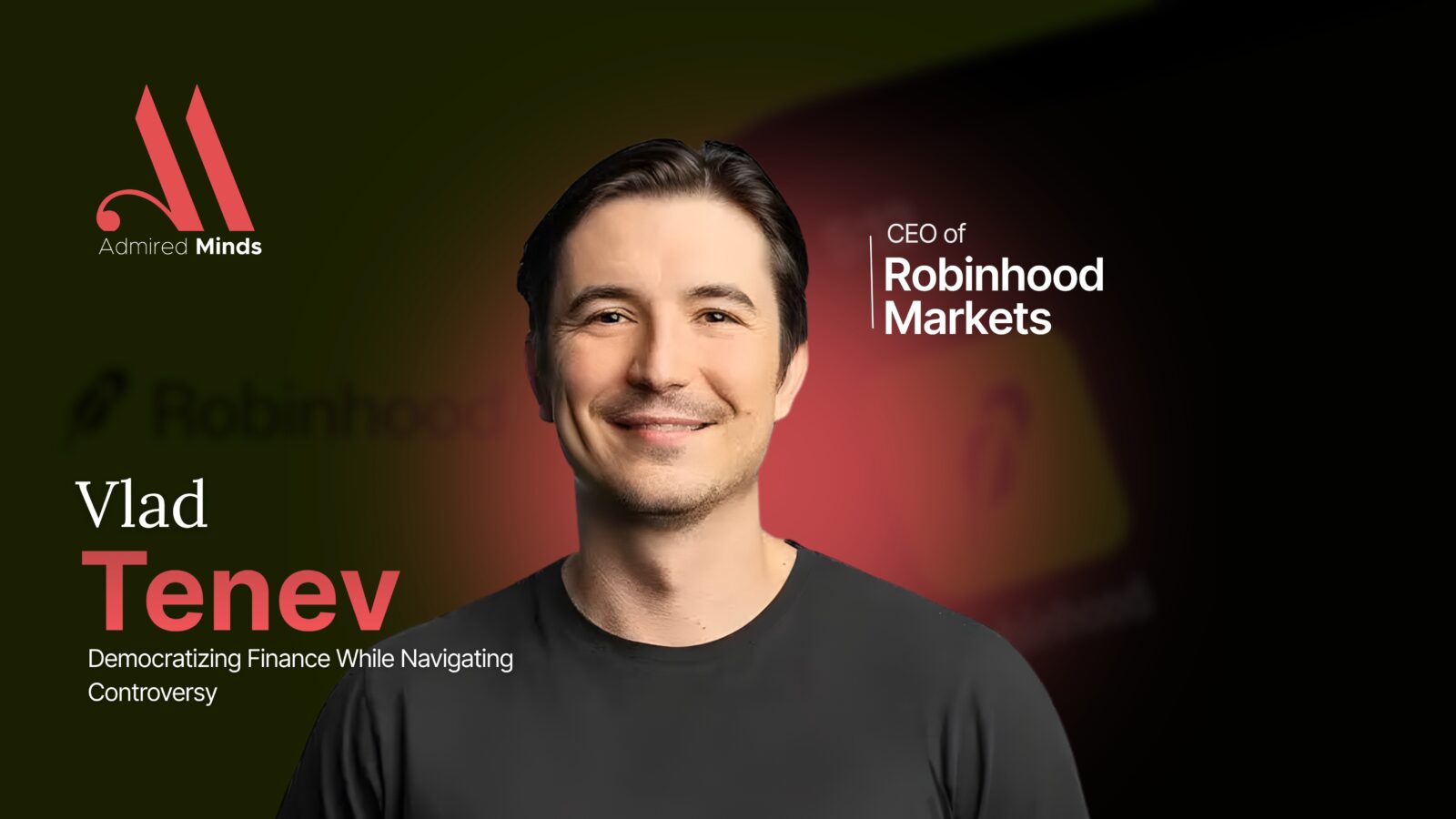
The $3 Billion Moment That Redefined Crisis Leadership
When Vlad Tenev appeared before Congress in February 2021 to explain Robinhood’s role in the GameStop trading frenzy, he faced what many considered a company-ending crisis. Trading restrictions had triggered accusations of market manipulation, user lawsuits, and congressional investigations. Yet Tenev’s measured, data-driven testimony delivered with characteristic calm precision not only weathered the storm but repositioned Robinhood as a catalyst for necessary market reform discussions.

“We believe everyone should have access to the financial markets, not just the wealthy,” Tenev stated during his opening remarks, articulating the mission that had driven his company from Stanford dorm room concept to a $32 billion public company.
His ability to maintain strategic focus during intense scrutiny demonstrated the crisis leadership skills that have defined his approach to building one of finance’s most controversial yet transformative platforms.
From Stanford Physics Lab to Wall Street Revolution
Tenev’s unconventional path to fintech leadership began with academic excellence in quantitative fields. Born in Bulgaria and immigrating to the United States as a child, he pursued mathematics at Stanford University before entering the physics PhD program. However, his entrepreneurial instincts soon redirected his trajectory toward technology and finance.
His first venture, Chronos Research, developed high-frequency trading software for hedge funds, giving him intimate knowledge of market microstructure that would prove invaluable years later. This experience revealed the technological advantages available to institutional investors but denied to individual traders, planting the seeds for Robinhood’s democratization mission.
The strategic insight that launched Robinhood emerged from recognizing a fundamental market inefficiency: commission fees created barriers that excluded younger and lower-income Americans from wealth-building opportunities. While traditional brokerages charged $7 to $10 per trade, Tenev and co-founder Baiju Bhatt identified payment for order flow as an alternative revenue model that could eliminate these barriers entirely.

Breaking the $10 Fee Barrier: The Zero Commission Masterclass
Tenev’s approach to the zero-commission brokerage model illustrates his framework for navigating regulatory complexity while maintaining mission focus. Building a commission-free platform required restructuring fundamental assumptions about brokerage economics and regulatory compliance.
“Our goal isn’t to break the system; it’s to make the existing system work for everyone, not just institutional players,” Tenev explained during a 2019 fintech conference.
The zero-commission framework demonstrated his unique strategic advantage: combining deep technical knowledge with regulatory sophistication to create sustainable business models that serve underserved markets. This approach has become his signature methodology identifying regulatory arbitrage opportunities that create genuine social value rather than exploiting loopholes.

When 28 Million Users Lost Their Voices: Turning Crisis Into Credibility
“Leadership during a crisis isn’t about perfect decisions; it’s about transparent communication and learning from mistakes while staying true to your mission,” Tenev reflected in a subsequent interview.
The GameStop trading restrictions in January 2021 represented Tenev’s most significant leadership test. User outrage and media criticism created an existential crisis requiring immediate strategic response. His initial response prioritized operational stability over public relations, focusing on securing additional capital and preparing detailed explanations for the technical factors necessitating trading restrictions.
Beyond the Trade Button: Building Tomorrow’s Financial Operating System

Tenev sees financial services evolving toward greater democratization and education. His strategic investments include expanding educational content, developing advanced portfolio management tools, and building retirement planning capabilities. He anticipates younger generations will demand integrated financial platforms that combine investing, banking, and financial planning in seamless digital experiences.
Strategic Takeaways
Mission-Driven Innovation Framework
- Identify systemic barriers that exclude underserved populations
- Develop sustainable business models that align profit with social impact
- Challenge industry assumptions while respecting regulatory boundaries
- Scale solutions that create genuine value rather than extractive opportunities
Regulatory Navigation Strategy
- Build deep expertise in relevant regulatory frameworks before launching
- Establish proactive relationships with regulatory bodies
- Design compliance systems that exceed minimum requirements
- Use regulatory challenges as opportunities to advocate for beneficial reforms
Crisis Leadership Through Transparency
- Prioritize operational stability over short-term reputation management
- Communicate complex technical issues in accessible language
- Accept responsibility while educating stakeholders about systemic factors
- Use crisis platforms to advocate for positive industry changes
Sustainable Growth Methodology
- Focus on long-term user success rather than short-term engagement metrics
- Invest in educational resources that improve user financial outcomes
- Build technological infrastructure capable of scaling responsibly
- Balance rapid growth with operational excellence and regulatory compliance









Leave a comment