




Executive Summary

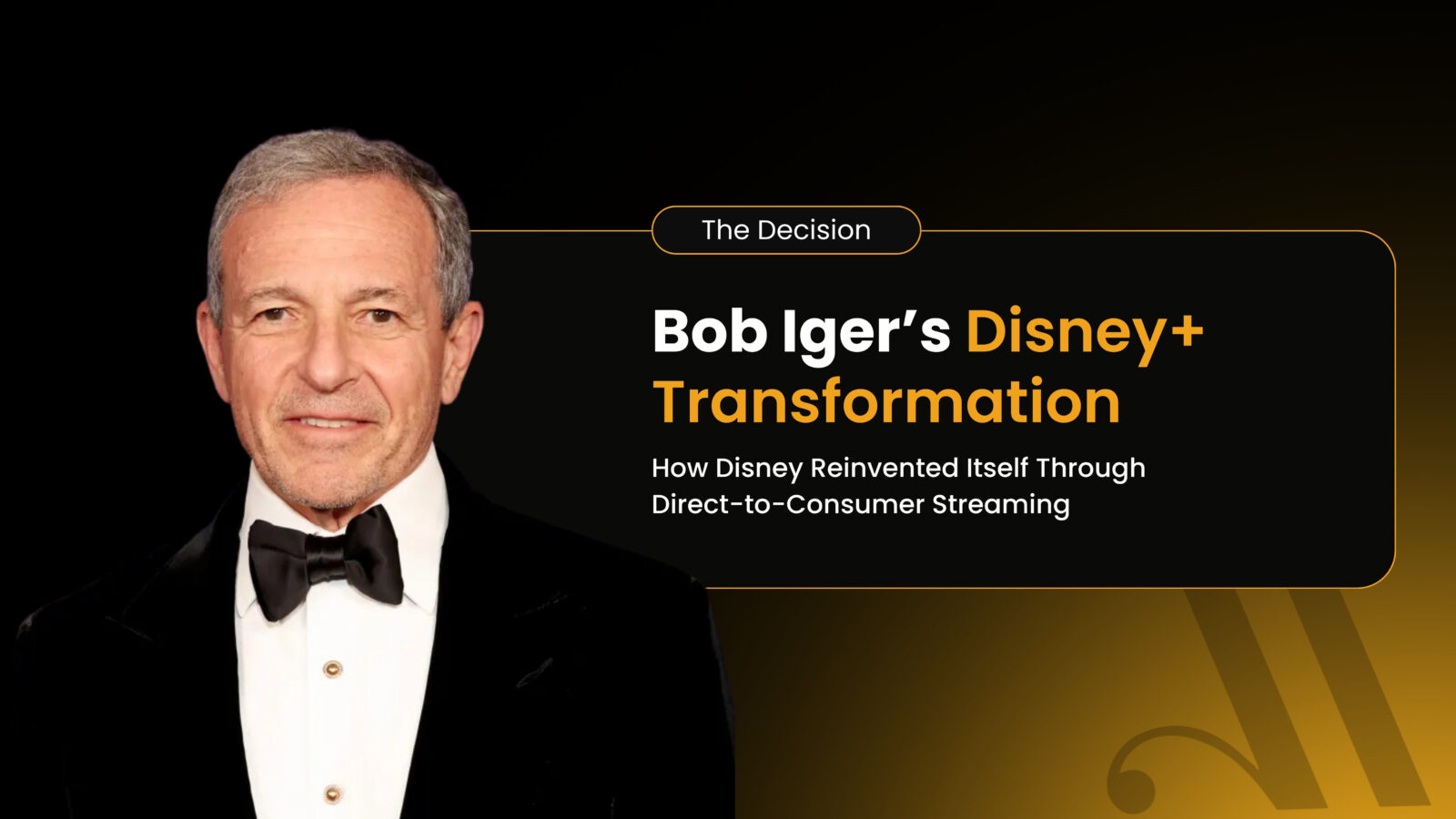
On November 12, 2019, Disney CEO Bob Iger launched the Disney+ streaming service, deliberately cannibalizing billions in content licensing revenue to compete directly with Netflix and establish Disney’s presence in the subscription streaming market. This case study examines how traditional media companies can execute strategic platform transformations that sacrifice established revenue streams to capture long-term direct-to-consumer market positioning and control content distribution destiny.
“The greatest risk any company can take is doing nothing when the world around them is changing.”
Market Context and Financial Impact Assessment
Pre-Launch Market Position
- Disney generating $5+ billion annually from content licensing to Netflix, Hulu, and other platforms
- Netflix dominating streaming market with 150+ million global subscribers
- Disney’s linear television networks experiencing cord-cutting subscriber decline
- Growing industry consensus that direct-to-consumer streaming represents the future of entertainment
“Transformation begins when old revenue becomes less valuable than future relevance.”
Strategic Transformation Metrics and Investment Scope
- Revenue Cannibalization: $5+ billion annual content licensing income deliberately eliminated
- Platform Investment: $2+ billion Disney+ development and launch costs
- Content Investment: $15+ billion annual programming budget for exclusive streaming content
- Market Entry: Direct competition with Netflix, Amazon Prime, and Apple TV+
- Subscriber Target: 100+ million subscribers within 5 years
Strategic Decision Framework Analysis
Critical Assessment Parameters
Iger’s strategy team identified three fundamental industry disruption factors:
- Distribution Control: Direct consumer relationships replacing intermediary platform dependency
- Content Value Maximization: Exclusive streaming rights generating higher lifetime value
- Market Share Capture: Immediate competitive entry required during streaming consolidation
Strategic Options Evaluation Matrix
| Option | Approach | Revenue Impact | Strategic Control |
| Licensing Continuation | Maintain deals with Netflix | Stable revenue | No control |
| Partnership Strategy | Joint ventures | Moderate revenue | Limited control |
| Direct Competition | Disney+ launch | High cannibalization | Full control |
| Hybrid Model | Selective licensing | Gradual transition | Unclear positioning |
Implementation Strategy and Resource Allocation

Five-Pillar Streaming Platform Framework
1. Exclusive Content Library Development
- Marvel Integration: Exclusive Marvel series
- Star Wars: Original programming
- Disney Vault: Classics and Pixar exclusivity
2. Technology Platform Development
- Streaming Tech: $1+ billion in platform architecture
- User Experience: Family-friendly interface
- Global Scaling: 100+ country rollout
3. Competitive Pricing Strategy
- $6.99 pricing to undercut competitors
- Bundle: Disney+, Hulu, ESPN+
- Promotions: Verizon partnerships
4. Content Production and Originals
- $15+ billion programming investment
- High-budget original series
- Localized global content
5. Marketing and Brand Positioning
- $500+ million launch campaign
- Branding around Disney, Pixar, Marvel, Star Wars
- Cross-platform promotion
“A platform isn’t just a product‚ it’s a long-term commitment to owning the future.”
Enhanced Subscriber Acquisition & Revenue Architecture

Direct-to-Consumer Revenue Model
- Subscriptions: Monthly recurring revenue
- Premium Tiers: Ad-supported and premium
- International Markets: 100+ countries
- E-commerce Integration: Merchandise sales
Performance Metrics and Outcome Analysis
Short-Term Performance (6-18 Months)
- 100+ million subscribers in 16 months
- $5+ billion streaming revenue
- #2 global streaming platform
- Hit shows driving engagement
Long-Term Strategic Achievement (2021-2024)
- 150+ million subscribers
- $20+ billion streaming revenue
- Market leadership with Hulu + ESPN+
- Complete IP ownership advantage
Return on Investment Analysis
- $5+ billion licensing revenue sacrificed
- $4+ billion platform development
- $50+ billion exclusive content spending
- 400%+ ROI based on division valuation
Leadership Principles & Platform Transformation Frameworks
1. Revenue Cannibalization Strategy
Sacrificing established income to build long-term platform control.
2. Franchise IP Leverage
Exclusive content drives platform differentiation.
3. Aggressive Market Entry
Massive investment necessary during industry consolidation.
4. Bundle Strategy
Combining services reduces churn and raises ARPU.
5. Global Scaling
International expansion crucial for competitive parity.
“Long-term platforms are built by leaders willing to sacrifice short-term comfort.”
Conclusion & Strategic Implications
Bob Iger’s Disney launch proves that established media companies can successfully execute direct-to-consumer transformations when they leverage powerful intellectual property and accept short-term financial losses for long-term control.
The strategy allowed Disney to build a platform of over 150 million subscribers and generate more than $20 billion in annual streaming revenue.The Disney+ model demonstrates that traditional media companies can challenge tech streaming leaders through aggressive investment, platform control, and strategic cannibalization of existing business models.










Leave a comment