




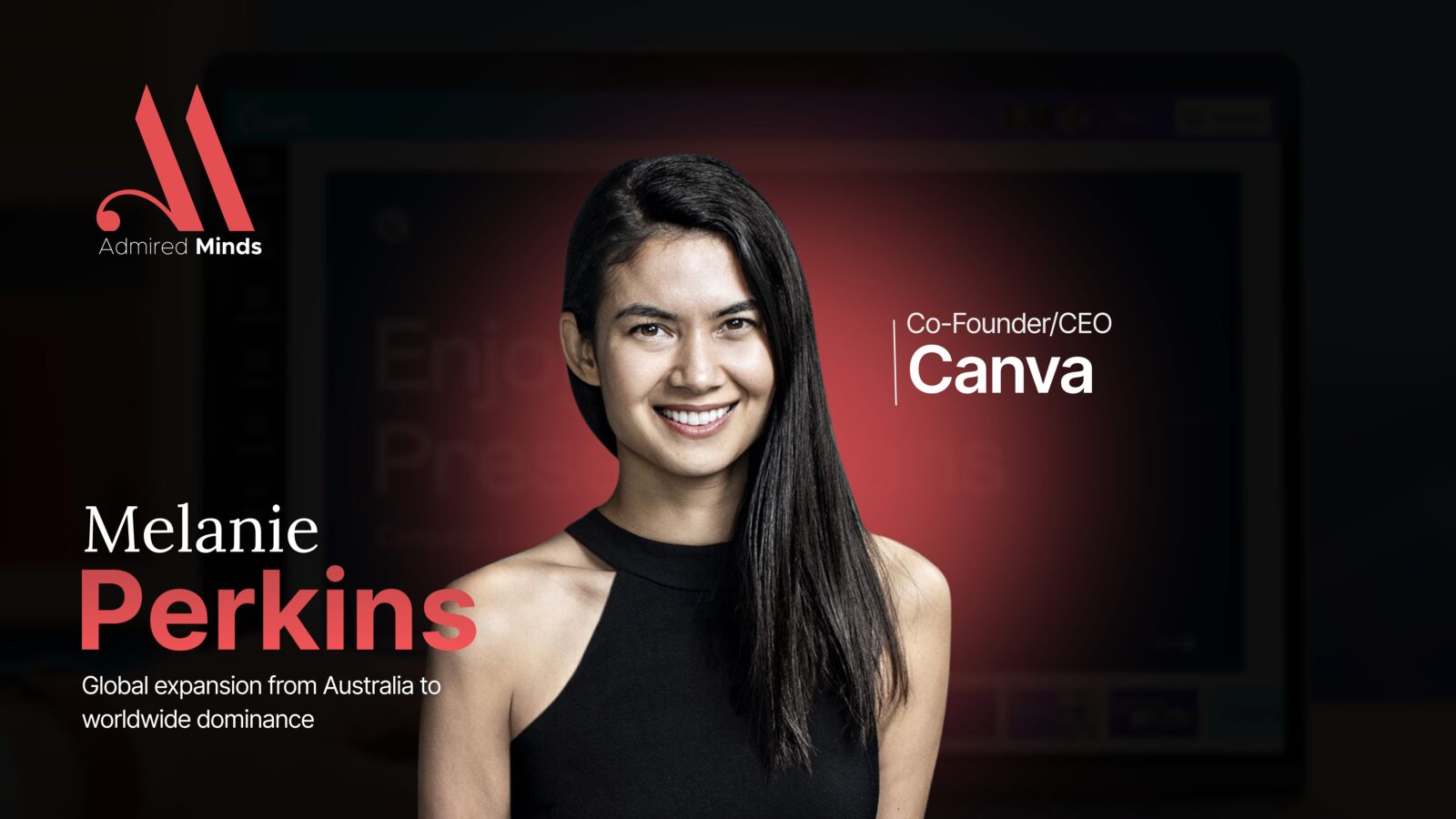
From 100 Rejections to Global Design Dominance

In 2011, when Melanie Perkins presented her vision for democratizing design to venture capitalists, one investor told her bluntly: “Graphics design is a complex field that requires years of training. You can’t just make it simple for everyone.” After 100 consecutive rejections and three years of fundraising failures, most entrepreneurs would have pivoted or given up. Instead, Perkins made a strategic decision that would reshape global creative industries: she would build Canva not from Silicon Valley, but from Sydney, targeting international markets first before conquering the design establishment.
That contrarian approach proved transformative. By 2022, Canva had achieved a $26 billion valuation with 165 million users worldwide, making it the world’s most valuable startup founded and led by a woman. More importantly, Perkins built what she calls “localized globalization,” expanding to 100 languages across 190 countries by treating each market as a unique ecosystem rather than simply translating an English-language product.
At 37, Perkins has created what industry analysts describe as the “Canva playbook” for global expansion: systematic localization, community-driven growth, and freemium models that prioritize accessibility over immediate monetization. Her approach to building worldwide dominance from Australia positions her as a strategic leader who understands how geographic constraints can become competitive advantages in the digital economy.
Teaching Design to Building Design: The Strategic Foundation for Global Thinking
Perkins’ path to global expansion began with local insights that others had missed. While teaching design fundamentals at university, she observed students struggling with complex software like Photoshop and InDesign not because they lacked creativity, but because the tools required technical expertise unrelated to design thinking.
This observation led to her first venture, Fusion Books, a web-based yearbook design platform that simplified desktop publishing for schools. The success of Fusion Books revealed strategic insights about user behavior that would become foundational to Canva’s global approach: people worldwide share similar creative needs but face different technological barriers and cultural contexts.
Her early fundraising failures provided unexpected strategic advantages. Instead of building with Silicon Valley assumptions about user behavior and market dynamics, Perkins developed what she calls “outsider perspective strategy,” analyzing global design needs without being constrained by existing industry models or geographic biases.
“Our goal was to take the entire design ecosystem, integrate it into one page, and then make it accessible to the whole world.”
The insight that led to Canva’s global design philosophy emerged from recognizing that this wasn’t just about simplifying tools‚Äîit was about creating a platform that could adapt to diverse cultural design preferences and workflow requirements.

Her strategic breakthrough was understanding that global expansion required building localization capabilities from the foundation, rather than adding international features later. This approach informed Canva’s technical architecture, team structure, and go-to-market strategy from launch day.
Localized Globalization: The Strategic Framework for Worldwide Market Penetration
Perkins’ approach to global expansion demonstrates sophisticated understanding of how technology companies can achieve worldwide dominance through systematic localization rather than universal standardization. Her strategy centers on what she terms “cultural-first product development,” building platform capabilities that adapt to local design preferences and communication styles.
The localization strategy went far beyond language translation. Starting with Spanish and expanding to 100 languages, including complex ones like Arabic, Hebrew, and Urdu, Canva invested in understanding how different cultures approach visual communication, color psychology, and design hierarchy.
Her framework involves three strategic layers: linguistic adaptation, cultural design integration, and local community building.
“We’re continuously making Canva feel like a local company wherever you are in the world.”
This approach required building international teams that understand local markets rather than simply deploying a universal product globally.
The strategic decision to prioritize international expansion over domestic market domination proved crucial during competitive battles with established players like Adobe. While competitors focused on defending their positions in developed markets, Canva built strong user bases in emerging markets where design tools had been previously inaccessible due to cost or complexity.
With a globally distributed team creating localized content and campaigns, Canva ensures every community feels connected. This approach created network effects where users in different countries became advocates for Canva within their local design communities, generating organic growth that traditional advertising couldn’t achieve.
The results demonstrate the business value of localized globalization: Canva now empowers more than 100 million users to design anything from social media graphics to presentations, challenging industry titans like Adobe while maintaining user engagement rates that consistently exceed industry benchmarks across diverse international markets.
Community-Driven Leadership: Building Global Scale Through Local Empowerment
Perkins’ leadership philosophy centers on what she describes as “distributed empowerment”‚Äîcreating systems that enable local teams and user communities to drive growth while maintaining platform coherence. This approach emerged from recognizing that traditional centralized management couldn’t effectively serve diverse global markets.
Her hiring strategy reflects sophisticated thinking about global team dynamics. Rather than building hierarchical international offices, Perkins created autonomous regional teams with decision-making authority over local market strategies. This structure enables rapid response to market-specific opportunities while maintaining global brand consistency.
The approach to product development demonstrates community-driven leadership in practice. Instead of dictating features from headquarters, Canva implements user feedback loops that prioritize requests based on regional usage patterns and cultural preferences. This process has led to features like right-to-left text support for Arabic users and specialized templates for local business contexts.
Her crisis management during rapid growth periods reveals strategic thinking about maintaining culture during international scaling. When Canva experienced explosive user growth during the 2020 pandemic, Perkins focused on preserving the company’s mission-driven culture across distributed teams rather than simply optimizing operational metrics.

The investment in education and community building extends beyond user acquisition to ecosystem development. Through Canva for Education and Canva for Work programs, Perkins built partnerships with educational institutions and businesses worldwide, creating sustainable user acquisition channels that align with Canva’s mission of democratizing design.
Beyond Design Tools: Strategic Vision for Creative Platform Ecosystem
Perkins’ current strategic focus involves evolving Canva from a design tool into comprehensive creative infrastructure that serves the entire visual communication workflow. Her vision centers on what she calls “end-to-end creative empowerment,” providing integrated capabilities that eliminate friction between creative conception and final execution.
This evolution reflects sophisticated understanding of how successful platforms expand: rather than adding unrelated features, Perkins is building deeper capabilities within the creative workflow while maintaining simplicity for basic users. Recent additions like video editing, presentation tools, and collaborative features demonstrate strategic thinking about user journey optimization.
Looking ahead, Perkins identifies three strategic opportunities shaping creative technology: integration of artificial intelligence into design workflows, development of collaborative creation tools for distributed teams, and creation of monetization systems that enable creators to build sustainable businesses using design platforms.
Canva strategically targeted enterprise and education sectors, tailoring features and pricing to meet the specific needs of these large-scale users while pursuing thoughtful acquisitions that enhance technological capabilities rather than simply acquiring users or market share.
“We want to empower everyone to create beautiful designs, regardless of their experience level or budget.”
For emerging leaders building global companies, Perkins emphasizes the importance of cultural intelligence:
“Don’t assume what works in your home market will work everywhere. Invest in understanding local needs, preferences, and workflows. The most successful global companies feel local everywhere they operate.”
Four Strategic Frameworks for Global Platform Expansion

Outsider Perspective Strategy: Leverage geographic or industry distance from established players to identify unmet needs and alternative approaches. Perkins’ Australia base enabled fresh thinking about global design needs without Silicon Valley assumptions.
Localized Globalization Framework: Build international expansion capabilities into product architecture from launch, rather than adding localization features later. This requires systematic cultural adaptation beyond simple language translation.
Community-Driven Growth System: Create user feedback loops and local advocacy programs that generate organic growth within regional markets. This approach builds stronger network effects than traditional centralized marketing strategies.
Distributed Empowerment Leadership: Structure international teams with local decision-making authority while maintaining global platform coherence. This enables rapid market response while preserving organizational mission and culture across diverse regions.











Leave a comment