




Executive Summary
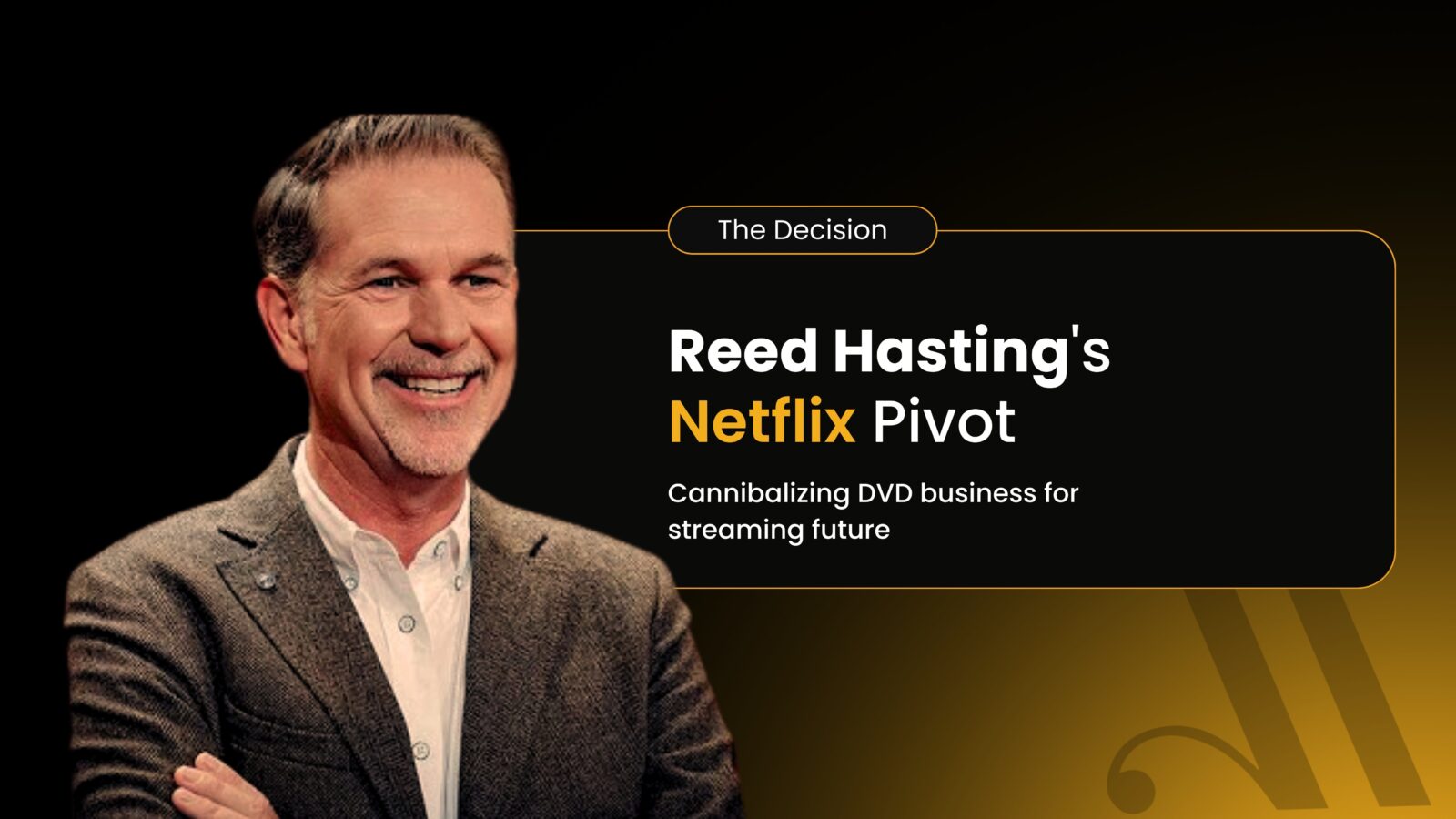
Between 2007-2012, Netflix CEO Reed Hastings executed a radical business model transformation that deliberately cannibalized the company’s profitable DVD-by-mail operation to establish dominance in streaming media. This case study examines how strategic self-disruption and future-focused investment during peak profitability can create insurmountable competitive advantages in emerging technology markets.

Market Context and Financial Impact Assessment
Pre-Pivot Market Position
- Netflix commanding 70% market share of DVD-by-mail rental market
- Peak DVD subscriber base: 20+ million customers generating $2+ billion annual revenue
- Profitable core business with established logistics infrastructure
- Growing competitive pressure from Redbox kiosks and digital alternatives
Transformation Metrics and Strategic Investment
- Revenue Cannibalization: Intentional decline from $2.16B (2010) to $1.8B (2012) in DVD revenue
- Streaming Investment: $6+ billion content acquisition and technology development commitment
- Market Share Shift: DVD dominance to streaming platform pioneer positioning
- Subscriber Migration: 8M streaming subscribers (2008) ‚33M (2012)

Strategic Decision Framework Analysis
Critical Assessment Parameters
Hastings’ leadership team identified three fundamental market disruptions:
- Technology Convergence: Broadband penetration reaching critical mass for video streaming
- Consumer Behavior Evolution: On-demand consumption preferences replacing scheduled delivery
- Content Distribution Revolution: Digital rights becoming available for direct licensing
Strategic Options Evaluation Matrix
| Option | Approach | Revenue Impact | Risk Profile |
|---|---|---|---|
| Status Quo Optimization | DVD business focus, streaming as supplement | Stable short-term growth | Technology disruption vulnerability |
| Gradual Transition | Balanced investment, market-driven migration | Moderate revenue decline | Competitive disadvantage, resource dilution |
| Aggressive Pivot | Streaming prioritization, DVD decline acceptance | Significant revenue cannibalization | Maximum transformation potential |
| Hybrid Strategy | Maintain both platforms equally | Resource strain, confused positioning | Operational complexity, strategic ambiguity |
Implementation Strategy and Resource Allocation
Five-Pillar Transformation Framework
1. Technology Infrastructure Development and Scalability
- Core Investment: $500+ million annual technology development spend
- Platform Strategy: Cloud-based streaming architecture for global scalability
- User Experience: Algorithm-driven personalization and recommendation systems
2. Content Acquisition and Original Programming Strategy
- Licensing Philosophy: Exclusive streaming rights over traditional media partnerships
- Investment Commitment: $100M+ per year content acquisition budget
- Original Content: “House of Cards” $100M bet on streaming-exclusive productions
3. Market Education and Consumer Behavior Modification
- Communication Strategy: Transparent explanation of strategic pivot rationale
- Value Proposition: Convenience and selection advantages over physical media
- Pricing Model: Competitive streaming subscriptions vs. DVD rental costs
4. Operational Excellence and Service Migration
- Dual Platform Management: Maintaining DVD quality while building streaming capabilities
- Customer Retention: Seamless transition programs for existing subscriber base
- Geographic Expansion: International streaming launch preparation
5. Competitive Differentiation and Market Positioning
- First-Mover Advantage: Streaming platform establishment before major competitors
- Brand Evolution: From “DVD-by-mail” to “streaming entertainment” company identity
- Technology Leadership: Innovation in streaming quality and user experience
Enhanced Value Creation and Content Strategy Architecture
Revenue Model Innovation Components
- Subscription Predictability: Monthly recurring revenue vs. transactional DVD model
- Global Scalability: Digital distribution eliminating physical logistics constraints
- Content Monetization: Original programming creating exclusive value propositions
- Data Optimization: Viewing analytics driving content acquisition and production decisions
Strategic Investment Program Framework
Content Development: $6+ billion annual programming budget evolution
Technology Innovation: Streaming quality improvements and platform features
International Expansion: Global market penetration through localized content
Original Programming: Emmy-winning productions establishing credibility
Performance Metrics and Outcome Analysis
Short-Term Impact Assessment (2007-2012)
- Stock Performance: 60% decline during transition period due to investor skepticism
- Subscriber Growth: Streaming subscribers growing 300% while DVD declined 40%
- Revenue Transition: Streaming revenue reaching $1.6B by 2012
- Competitive Position: Clear market leadership in emerging streaming category
Long-Term Strategic Victory (2013-2020)
- Market Capitalization: Growth from $3B (2007) ‚$240+B (2021)
- Global Subscriber Base: 200+ million streaming subscribers across 190+ countries
- Industry Transformation: Netflix model adopted by Disney, HBO, Amazon, Apple
- Content Leadership: Original programming winning Oscars and Emmy awards
Return on Investment Analysis
- Cannibalization Cost: $400+ million annual DVD revenue decline accepted
- Technology Investment: $3+ billion streaming infrastructure development
- Content Investment: $15+ billion cumulative original programming spend
- Strategic ROI: 8,000%+ return based on market capitalization growth
Strategic Leadership Principles and Best Practices
Core Leadership Frameworks

1. Self-Disruption Before Market Disruption
Proactively cannibalizing profitable business models prevents competitors from disrupting market position through superior technology or customer experience.
2. Future Value Creation Over Present Optimization
Strategic leaders prioritize emerging market opportunities over maximizing current revenue streams when technology shifts create paradigm changes.
3. Consumer Behavior Anticipation Strategy
Understanding latent consumer preferences enables market creation before demand becomes obvious to competitors.
4. Technology-Enabled Business Model Innovation
Leveraging emerging technologies to create fundamentally superior value propositions rather than incremental improvements.
5. Strategic Courage Under Financial Pressure
Maintaining long-term strategic vision despite short-term financial performance decline and investor skepticism.
Decision-Making Framework for Business Model Transformation
Five-Factor Strategic Disruption Model
When evaluating self-cannibalization opportunities, leadership teams should assess:
- Technology Maturity: Infrastructure readiness for alternative business model execution
- Consumer Readiness: Market adoption indicators for new consumption patterns
- Competitive Timeline: Window of opportunity before major competitors enter market
- Financial Capacity: Organization’s ability to sustain revenue decline during transition
- Strategic Vision Alignment: Leadership commitment to long-term transformation over short-term optimization
Risk Mitigation Indicators
- Maintaining customer satisfaction during platform migration
- Technology infrastructure scaling with subscriber growth
- Content acquisition securing competitive streaming library
- Financial management during revenue transition period
Performance Measurement Criteria
- Streaming subscriber acquisition and retention rates
- Content engagement metrics and viewing time
- Technology platform reliability and user experience scores
- Market share growth relative to emerging competitors
Conclusion and Strategic Implications
Reed Hastings’ Netflix streaming pivot demonstrates that strategic self-disruption creates sustainable competitive advantages when executed before market forces demand transformation. The decision to deliberately cannibalize $2+ billion in DVD revenue generated over $200 billion in market value creation, proving that future-focused strategic courage produces exponential returns.

This case study illustrates that timing of business model transformation determines market leadership potential, suggesting proactive disruption is a strategic investment in technology evolution rather than merely operational risk management. Embracing short-term financial sacrifice for long-term dominance provides a framework for industry transformation.
“Proactive disruption is not a risk‚ it’s the investment that ensures market leadership in technology-driven industries.”











Leave a comment