




In March 2012, when Joshua Kushner decided to lead Instagram’s Series B round at a $500 million valuation, fellow VCs called it recklessly overpriced for a photo-sharing app with no revenue model. Traditional venture wisdom suggested diversifying across many smaller bets rather than concentrating significant capital in unproven companies. But Kushner made a strategic decision that would define his investment philosophy: as the second largest investor in Instagram’s Series B, Thrive doubled its money when Facebook acquired the company, validating his contrarian approach¬†to concentrated, conviction-driven investing.
That strategic framework has since produced extraordinary returns. Thrive has ultimately invested around $1.3 billion in OpenAI since its inception, leading funding rounds that valued the company at $157 billion by 2024. More importantly, Kushner has built what industry observers describe as the “anti-spray-and-pray”¬†model‚Äîinvesting heavily in fewer companies to provide closer relationships with founders and more visibility into companies.
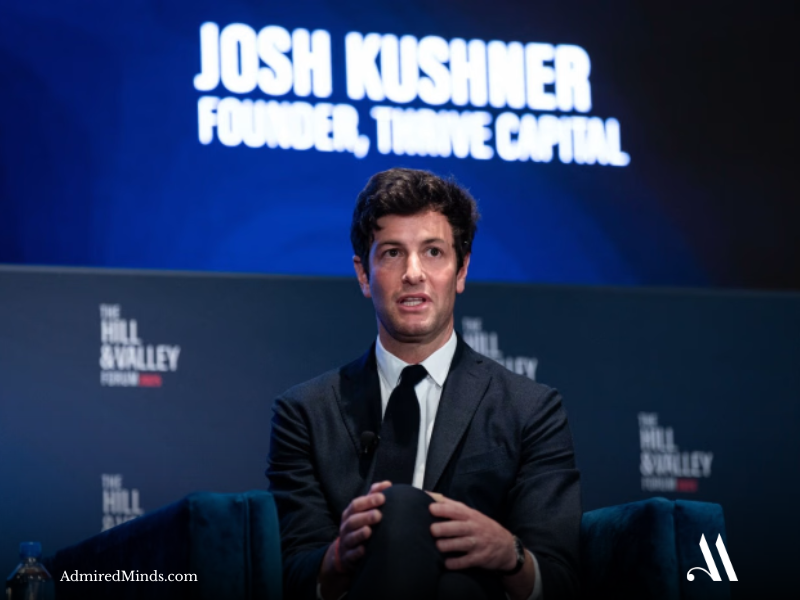
At 39, Kushner has demonstrated what he calls “concentrated conviction investing”‚Äîbuilding deeper relationships with fewer companies rather than diversifying across hundreds of startups. His recent $5 billion Thrive IX fund, comprising $1 billion for early-stage and $4 billion for growth-stage investments, positions him as a strategic leader redefining how venture capital can create value through focus and relationship depth rather than portfolio breadth.
The Founder-First Methodology
From Harvard Undergraduate to Billionaire Investor: The Foundation of Relationship-Driven Venture Capital
Kushner’s approach to venture capital emerged from recognizing that successful investing requires understanding founders and markets at deeper levels than traditional due diligence processes allow. Starting Thrive Capital at age 24 with initial $5 million seed funding from Joel Cutler and General Catalyst, he developed what he now calls the “founder-first methodology.”
His strategic insight centered on building relationships with exceptional entrepreneurs¬†before they needed capital, rather than competing in auction processes after companies achieve obvious traction. When Sam Altman needed to call venture capitalists about OpenAI’s growth, “the first person Altman dialed wasn’t a larger-than-life Silicon Valley titan like Marc Andreessen or Peter Thiel‚Äîit was Joshua Kushner.”
The investment philosophy he developed reflects sophisticated understanding of how network effects operate in venture capital. Rather than relying on deal flow from traditional channels, Kushner built systematic approaches to identifying exceptional founders early in their careers, then maintaining relationships through multiple ventures and market cycles.
His early success with companies including Instagram, GitHub, Spotify, and other transformative platforms revealed strategic thinking about platform businesses and network effects that would inform his later concentration strategy. These investments demonstrated the ability to identify companies that would define rather than merely participate in their categories.
The decision to base Thrive Capital in New York rather than Silicon Valley reflected contrarian thinking about venture capital geography. This positioning enabled access to different founder networks and business models while avoiding the groupthink that sometimes characterizes traditional venture clusters.
The Strategic Architecture of Concentrated Conviction
Concentrated Conviction: The Strategic Architecture of Next-Generation Venture Capital
Kushner’s investment strategy demonstrates a sophisticated understanding of how concentrated portfolios can generate **superior returns** through deeper engagement rather than diversification-based risk management. His concentrated investment strategy builds a highly diversified portfolio spanning high-growth companies, unicorns, and transformative investments.
The methodology involves three strategic layers: relationship development that begins before fundraising needs, systematic assessment of market timing and competitive dynamics, and **ongoing operational support** that extends beyond capital provision. This approach creates sustainable competitive advantages through information asymmetry and founder loyalty.
His framework for company evaluation emphasizes what he describes as “transformational potential”‚Äîidentifying businesses that can reshape entire industries rather than incrementally improve existing solutions. His investment strategy aligns with the long-term vision advocated by renowned investors like Charlie Munger and Warren Buffett, expressing confidence in companies’ potential to emerge as key players alongside industry giants like Google and Meta.
The OpenAI relationship exemplifies this strategic approach in practice. Rather than simply providing capital, when chaos unfolded during OpenAI’s leadership crisis, “the first call that Brad Lightcap, OpenAI’s chief operating officer, made was to Joshua Kushner”, demonstrating the operational partnership role¬†that concentrated investing enables.
The concentration strategy extends to operational involvement. Instead of serving on dozens of boards with limited engagement, Kushner focuses intensively on fewer companies where Thrive can provide meaningful strategic guidance during critical growth phases and market transitions.
Partnership-Driven Leadership
Building Sustainable Founder Relationships at Scale
Kushner’s leadership philosophy centers on what he describes as “authentic partnership”‚Äîbuilding relationships based on shared long-term vision rather than transactional capital provision. This approach proved essential during crisis periods when founders need strategic guidance rather than just financial resources.
His team building strategy reflects sophisticated thinking about venture capital organization. Rather than hiring traditional finance professionals, Kushner recruits individuals with operational expertise who can provide practical guidance to portfolio companies facing scaling challenges.
The firm structure he created enables rapid decision-making while maintaining systematic investment processes. Thrive’ s approach to being “concentrated in both people and ideas”¬†creates organizational focus that matches investment philosophy, enabling deeper relationships with both team members and founders.
His crisis management during market downturns demonstrates values-based leadership under pressure. Rather than abandoning struggling portfolio companies or demanding immediate returns, Kushner consistently provides additional support to help founders navigate difficult periods while preserving long-term partnership relationships.
The mentorship approach extends beyond formal investment relationships to ecosystem building. Through speaking engagements, industry involvement, and founder introductions, Kushner creates value networks that benefit portfolio companies while strengthening deal flow and market insights.
Vision: Beyond Traditional Venture Capital
Strategic Vision for Investment Evolution and Market Leadership
Kushner’s current strategic focus involves expanding beyond traditional venture capital to comprehensive growth capital¬†that can support companies throughout their entire scaling journey. His expansion beyond venture reflects a broader industry split between mega-funds taking multi-strategy bets and boutique funds keeping to old Silicon Valley traditions.
The evolution to growth-stage investing alongside early-stage work demonstrates strategic thinking about venture capital’s future. Rather than limiting involvement to startup phases, Thrive now provides capital and guidance through IPO and public market transitions, creating longer-term partnership opportunities.
Looking ahead, Kushner identifies three strategic opportunities shaping venture capital:
- Integration of artificial intelligence into investment analysis and portfolio management.
- Development of operational support systems that provide systematic value beyond capital.
- Creation of founder networks that enable knowledge sharing across portfolio companies.
His long-term vision involves what he calls “institutional partnership”‚Äîventure capital that operates more like strategic consulting than pure financial investment. This approach creates competitive advantages through operational expertise while generating returns through sustained company growth rather than quick exits.

As he describes his philosophy: “Venture capital works best when it’s concentrated, authentic, and focused on long-term partnerships. The goal isn’t to have the largest portfolio‚Äîit’s to identify the companies that will define their industries, then support them at the highest level throughout their growth journey.”
Key Strategic Frameworks of Thrive Capital
Four Strategic Frameworks for Next-Generation Venture Capital
- Concentrated Conviction Strategy: Focus investment capital and attention on fewer, higher-conviction opportunities rather than diversifying across many smaller bets. This creates deeper founder relationships and better company outcomes through sustained engagement and operational support.
- Founder-First Methodology: Build relationships with exceptional entrepreneurs before they need capital, creating informational advantages and partnership opportunities that pure deal-flow approaches cannot achieve. This enables participation in the most competitive rounds through relationship priority.
- Transformational Potential Assessment: Evaluate companies based on their ability to reshape entire industries rather than incrementally improve existing solutions. This framework identifies businesses with sustainable competitive advantages and significant return potential over traditional optimization plays.
- Authentic Partnership Leadership: Structure investor-founder relationships around shared long-term vision and operational collaboration rather than purely financial arrangements. This approach creates mutual commitment that sustains through market cycles while enabling better strategic decision-making.

***
Ready to adopt a high-conviction approach to your investments? Explore the companies that are currently redefining their markets.
**Learn More About Concentrated Investment Strategy.**
***
‚ÄúOur focus is always on the compound effect of great decisions over a long period of time, rather than trying to optimize for one great exit. That’s how real, generational companies are built.‚Äù
— Joshua Kushner









Leave a comment